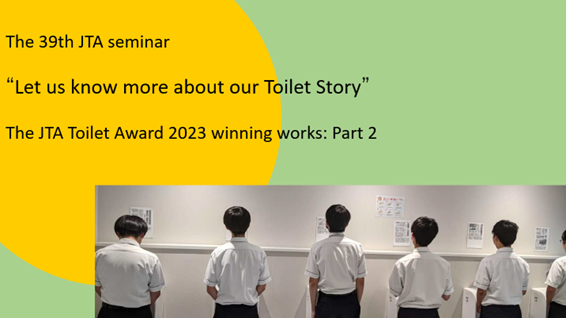
“Referring to the JTA Toilet Award 2023 winning works: Part 2” Date: 12 September 2024 (Thu)
Moderator / Presenters
- <Presenter 1> “NIE Activities in the Field of Toilets” Sora Inosako, Yuma Sato, Shinichiro Ando (Students of Nihon Bunri University High School)
- <Presenter 2> “Improving Toilet Maintenance Efficiency with IoT: Smart SA Management System” Saki Shimaura (Central Nippon Expressway Co., Ltd.)
- <Presenter 3> “A Challenge to Extending the Lifecycle of Toilet Bowl in the SDGs Era: Coating for Railway Station Toilets”
Takeshi Yoshimaru, Masaru Nakayama, Katsuya Ariizumi (Odakyu Building Service Co., Ltd.) - <Moderator>Koji Yamamoto (Director, Japan Toilet Association / Central Nippon Expressway Co., Ltd.)
Presentation Outline
(Yamamoto, Moderator)
Today, we will hear from the recipients of the 2023 JTA Toilet Awards.
The first presentation is by Mr. Inosako, Mr. Sato, and Mr. Ando from Nihon Bunri University High School, introducing their Newspaper in Education (NIE) initiative in which newspaper articles are displayed in toilets to give students opportunities to read.
The second is by Ms. Shimaura of Central Nippon Expressway Co., Ltd., who will introduce efforts to use IoT technology for next-generation toilet maintenance.
The third presentation is by Mr. Yoshimaru, Mr. Nakayama, and Mr. Ariizumi of Odakyu Building Service Co., Ltd., who will discuss their challenge of extending equipment life cycles in an age where SDGs-oriented social initiatives are increasingly important.
Before we begin, we will have an explanation about the JTA Toilet Awards from Ms. Azai.
(Azai)
The JTA Toilet Awards recognize individuals and groups who conduct outstanding activities or proposals that contribute to creating toilet environments people can use comfortably anytime and anywhere, and to realizing a society where such environments can be sustained.
The awards promote exemplary initiatives in toilet environment development. The award has a long history, originating from the “Good Toilet 10 Awards” launched in 1985 when the Japan Toilet Association was founded. In 2009, it was renewed as the “Good Toilet Selection.” Initially, the awards evaluated public toilet improvements based on their physical design and facilities. Over time maintenance and social initiatives increased, and in 2021, the awards were reorganized into four categories. Beginning in 2024, the name was changed to the “JTA Toilet Awards.”
By applying, entrants receive evaluations from experts in the field. Winning works may also be featured in newspapers and industry journals. As only one sheet of material can be submitted for applications, this program—“Let us know more about our Toilet Story”—allows recipients to share their initiatives in greater detail.
Presentation 1: NIE Activities in the Field of Toilets Inosako, Sato, Ando (Nihon Bunri University High School)
(Yamamoto)
We will begin with the award-winning team from Nihon Bunri University High School. They received the Humor Award in the Social Activities category.
Comments from Judge Yoshihiko Kawauchi:
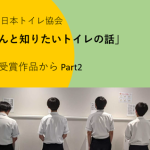
“The photographs in the materials are excellent. In urinals, people often feel conscious of those beside them. Yet in this photo, the boys stand side-by-side, fully absorbed in reading the newspaper posted in front of them. The articles will surely penetrate deeply into their refreshed minds after relieving themselves. Had I been able to read newspapers earnestly during my toilet visits when I was young, I might have become a slightly better person.”
(Sato)
Our school is a private high school in Saiki City, Oita Prefecture, with about 500 students across six classes per grade, divided into university-preparatory, qualification-focused, and career-oriented courses.
The toilets are equipped with full-length mirrors, shower toilet seat, and in the girls’ toilets, sound-masking devices.
Our NIE Activities in the Field of Toilets involved displaying newspaper articles in the toilets to create opportunities—one might say forcibly—for students to read the news. We started this activity because we thought it would be useful if students could absorb some social information even while using the toilet. The award and our initiative were featured on television.
(Inosako)
We are happy to have received the Humor Award. We hope to continue this activity.
Q&A
(Kawauchi)
The idea of having newspaper articles directly visible in front of users is excellent.
You mentioned that you would like to continue this activity, and what I would particularly like to ask going forward is that you look into how the students who are reading the articles actually feel about them, and whether newspaper articles are truly useful to them. I do not think they are something that yields immediate benefits, but they are, in my view, a very effective tool for understanding broader social trends. If you could also examine the attitudes with which the students read the articles, or how their perception of “toilet time” has changed as a result, I believe this would make for a very interesting piece of research.
(Inosako)
We would like to conduct surveys across the entire school to find out which articles students find useful and what types they want to read.
(Hosono)
When I was a student some 70 years ago, I was on the newspaper committee. Choosing new and interesting articles was always difficult. How do you select the articles you post?
(Sato)
We choose articles that seem easy for high school students to understand and that will capture their interest. They are currently posted only in front of urinals, but we plan to post them in the toilet cubicles as well.
Presentation 2: Improving Toilet Maintenance Efficiency with IoT: Smart SA Management System Saki Shimaura (Central Nippon Expressway Co., Ltd.)
(Yamamoto)
Our second presentation is from Ms. Shimaura of Central Nippon Expressway Co., Ltd., recipient of the Encouragement Award in the Maintenance/Management/Operation category.
Judge Nobutaka Yamato commented:
“In creating a comfortable toilet environment, it is important to foster an awareness of “aiming for clean toilets,” but what is even more important is to address each issue based on objective facts. This initiative is an excellent system in which usage data collected by numerous sensors are stored in the cloud, enabling cleaning staff and maintenance managers to share issues in real time and work toward their resolution. Going forward, I look forward to seeing reports on the results of its implementation, and to the widespread adoption of such systems.”
Additional comments from Judge Koji Yamamoto:
“The initiative to create comfortable and optimized toilet spaces through the use of ICT technologies deserves recognition in terms of its novelty, comfort, and advanced nature. At present, the number of pilot sites remains limited, and there still appear to be issues to be addressed, such as reviewing the specifications of sensors, data processing methods, and display interfaces based on evaluation and verification results from early implementation sites. Nevertheless, with the aim of enhancing customer satisfaction (CS) and employee satisfaction (ES) in toilet spaces, I hope that continued efforts will be made to pursue ongoing improvements in addressing these challenges.”
(Shimaura)
During development, we interviewed our cleaning staff (known as Area Cast members at NEXCO) to identify what they wanted automated or digitized. Based on their feedback, we digitized toilet usage situation, liquid soap and paper supply levels.
The system was first introduced in 2022 in restrooms on the eastbound TOMEI Expressway and westbound Seisho PA. Area Cast members were given tablets to monitor toilet conditions. Because some Area Cast members are older, we also installed touch-panel monitors in supply rooms to provide easier access.
We are currently developing an additional system, which we call the “malfunction reporting tool.”
In the past, when a problem occurred in a toilet facility, it was recorded as a handwritten note in a notebook kept inside the toilet. The information from these notes was then entered into formats such as Excel by employees of group companies at each office, shared with the relevant NEXCO personnel, and repair requests were made accordingly. As a result, a considerable amount of time was required from the discovery of a problem to its repair.
With the newly developed “malfunction reporting tool,” Area Cast members can promptly report equipment malfunctions to the relevant parties directly from the tablets provided to them. This mechanism shortens the time from problem detection to repair and contributes to improved customer satisfaction (CS).
Q&A
(Hosono)
Since many Area Cast members are older, did you make any special design considerations for the tablet interface?
(Shimaura)
Yes. We designed screens so users can understand key information—such as liquid soap levels—at a glance without needing to operate anything.
Presentation 3: A Challenge to Extending the Lifecycle of toilet bowl in the SDGs Era: Toilet Coating for Railway Station Toilets
Yoshimaru, Nakayama, Ariizumi (Odakyu Building Service Co., Ltd.)
(Yamamoto)
Our final presentation is from Odakyu Building Service Co., Ltd. Their project received the Encouragement Award in the Social Activities category.
Comments from Judge Kohei Yamamoto:
“The proposal reduces replacement costs by extending the service life of existing toilet bowl through surface treatment. This method is highly effective for stations with numerous fixtures and can also apply to general buildings, contributing to waste reduction and CO₂ reduction.”
Comments from Judge Kazunori Nakano:
“Surface treatment of toilet bowls is not new in itself, but if this initiative were to be implemented in the toilets of all stations, the scale would be immeasurable. The effects would be significant in terms of reducing waste generation, preventing carbon dioxide emissions associated with disposal, and lowering costs. As an SDGs awareness-raising initiative that poses an important question to society, its significance can be highly appreciated.”
(Nakayama)
We are responsible for cleaning all Odakyu Line stations. Because these stations serve city centers and tourist destinations, their toilets see far more use than typical public toilets, causing faster equipment deterioration. Traditionally, we relied on replacements, but as minimizing waste became more important, we began exploring ways to extend equipment life cycles.
Since there were no issues with the structural strength of the ceramic toilet bowls themselves, this initiative addressed surface deterioration through surface treatment. A glass coating was applied to the surface of the sanitary ware.
The specific refinishing process for the ceramic surface is as follows: first, the surface is sanded with 320-grit waterproof sandpaper, then progressively smoothed with 600-grit paper. Fine scratches are removed using 1000-grit paper, and finally the surface is polished with 3000-grit compound to achieve a smooth, mirror-like finish. After the polishing residue adhering to the ceramic is rinsed off with water, the surface is dried using a dryer. A glass coating agent is then applied and left to dry.
When toilet ware is replaced, work often involves modifications to plumbing and floor surfaces, requiring two nights of overnight construction. As a result, the facility is partially or completely closed for at least one day, causing inconvenience to customers. In contrast, the refinishing method introduced here can be completed in a single night of work, minimizing inconvenience to users while also reducing waste materials. Furthermore, the construction cost was reduced to approximately one-tenth of that required for replacing toilet ware.
(Ariizumi)
The Odakyu Group operates an initiative called the “Environmental Awards.” Through this program, initiatives undertaken by workplace groups within Odakyu Group companies, as well as by individuals, are recognized and their contents are shared both internally and externally. The aim is to promote the horizontal deployment of environmental activities, raise employee awareness, and encourage the development of proactive initiatives, thereby energizing the Odakyu Group’s overall environmental efforts. This year marked the second time the awards have been held, and this activity was also submitted for consideration.
As a result, out of more than twenty submissions from across the Odakyu Group, this initiative received an Excellence Award. In addition to having received an Encouragement Award at the JTA Toilet Awards, it also won an Excellence Award in the Odakyu Group’s Environmental Awards. When applying for the Environmental Awards, we included the judges’ comments from the JTA Toilet Awards. This demonstrated that the initiative had also been highly evaluated by toilet specialists, which ultimately contributed to its selection for the Excellence Award.
Q&A
(Hosono)
How long does the toilet coating last ?
(Nakayama)
About 2–3 years. After that, we repeat the sanding and recoating process.
(Nakamori)
Porcelain typically doesn’t deteriorate quickly. How old were the toilets you coated?
(Nakayama)
At least 30 years old.